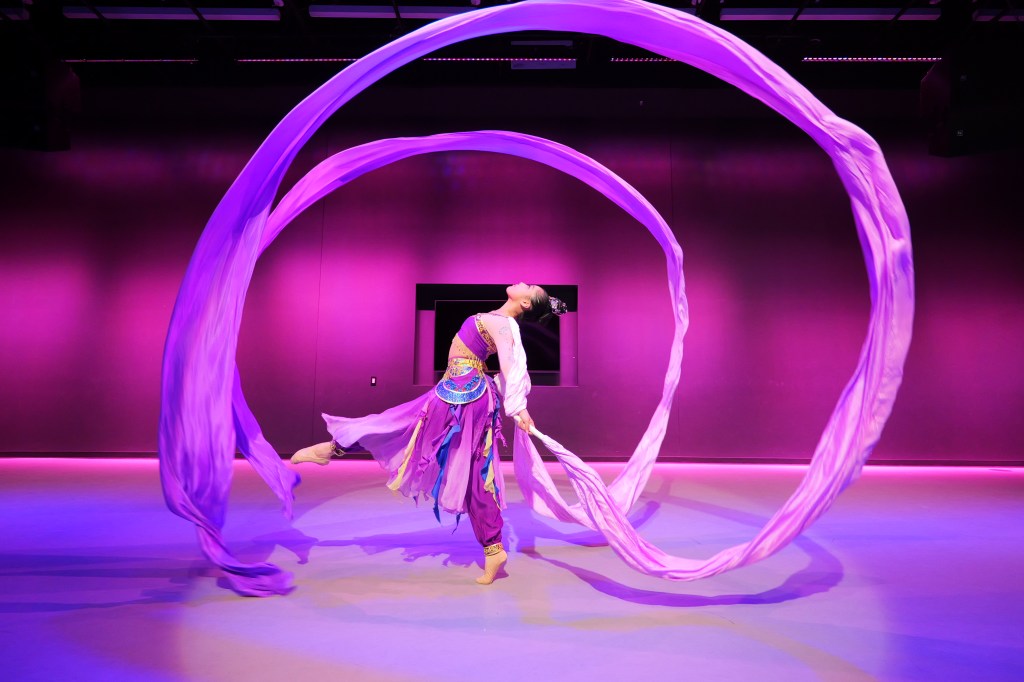
The complicated history of preserving a dance form that has never stopped changing.
A dancer raises her arms, allowing two long silk sleeves to fall behind her. With a turn of her wrist, the fabric circles through the air before settling at her feet. To an audience, the movement might look like something performed in an imperial Chinese court hundreds of years ago.
But how much of what we’re watching actually comes from ancient China?
I’ve practiced Chinese traditional dance for years, learning everything from Dunhuang-inspired choreography to long-sleeve techniques. When rehearsing, I often hear corrections about keeping a movement traditional. A wrist should turn a certain way. The shoulders should remain relaxed. A particular gesture should look softer.
Yet I’ve also performed choreography that incorporates ballet extensions, contemporary floorwork, and formations designed for modern stages.
If these additions change the movements, can we still call the dance traditional?
A Tradition That Was Recreated
When I first began researching Chinese dance history, I assumed that Chinese classical dance had developed gradually over thousands of years, with each generation passing its movements to the next. Yet history is much more complicated.
In Revolutionary Bodies: Chinese Dance and the Socialist Legacy, dance historian Emily Wilcox examines how Chinese dance developed during the twentieth century, particularly after the establishment of the People’s Republic of China in 1949.
Rather than treating Chinese classical dance as an ancient form preserved without interruption, Wilcox explains how choreographers developed a modern performance genre using historical materials, regional dance practices, Chinese opera, and other influences.
Many of the movements audiences now recognize as Chinese classical dance were organized into formal training systems during this period.
This distinction matters because the dancers not only reproduced choreography from the Tang or Han dynasties, but also studied historical traditions and developed ways to represent them onstage.
An ancient painting might show a dancer holding a particular pose, but it cannot tell us precisely how she entered that position, how quickly she moved, or what happened during the next musical phrase. Choreographers, on the other hand, had to make those decisions themselves.
The finished dances could be informed by history without being exact reproductions of it.
What Are We Actually Preserving?
Consider water sleeves, the long extensions of fabric attached to a dancer’s costume.
Water-sleeve techniques are closely associated with Chinese opera, where performers use the fabric to express emotion and develop a character’s movements. Today, long sleeves also appear in Chinese classical dance productions, sometimes in choreography inspired by ancient court performances.
The fabric might be the most recognizable part of the performance, but the technique involves much more than moving one’s arms.
A dancer must coordinate the wrist, elbow, shoulder, and torso to send the sleeves outward. The fabric continues moving even after the arm stops. A poorly timed turn can leave the sleeves tangled around the dancer’s body.
When choreographers introduce new turns or larger extensions, the technique changes. The resulting movement might be more dramatic, but it can also shift attention away from the controlled gestures associated with the original performance tradition.
So which part deserves preservation? The costume? The movement technique? The meaning behind the gesture?
When Choreographers Began Looking Backward
Wilcox’s research also examines debates surrounding the development of Han-Tang Chinese classical dance.
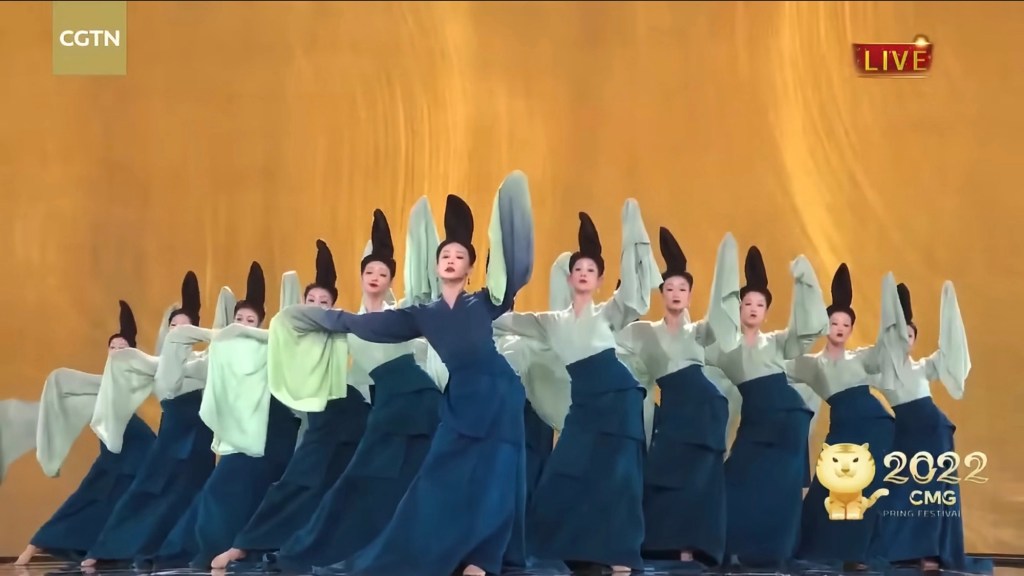
This approach draws inspiration from historical representations of dance, including visual materials associated with the Han and Tang periods. Its development reflects an effort to reconsider how Chinese classical dance should represent the country’s earlier artistic traditions.
But the historical sources present a challenge: Though a sculpture can reveal the shape of a dancer’s body, and a mural can show the placement of her arms and the direction of her gaze, neither provides a complete record of the choreography.
Modern artists must interpret what those images might have looked like in motion, and two choreographers studying the same image may produce entirely different dances.
For instance, one might emphasize restrained movements and detailed hand gestures. Yet another might build a larger stage production with extended sequences, elaborate formations, contemporary movements.
Yes, both were inspired by history. But neither could claim to have recovered every movement exactly as it was performed centuries ago.
This is what makes the question of authenticity so difficult. Historical inspiration is not the same as historical certainty.
The Problem With Calling Something Traditional
I find this especially interesting when comparing Chinese classical dance with ballet.
Ballet has changed enormously since its development in European courts. The pointe technique, physical expectations, and choreography performed by professional companies today are different from those of earlier centuries.
Yet we rarely question whether a contemporary ballet company is still performing ballet simply because its dancers use techniques that developed later.
Chinese classical dance presents a different challenge because its name often encourages audiences to associate the form directly with ancient China.
As Wilcox explains, Chinese classical dance is a modern concert dance genre that draws from historical Chinese aesthetics. Its modern development is part of its history, not something that can be separated from it.
This doesn’t mean every choreographic change is automatically appropriate.
A performance can borrow Chinese costumes and music while abandoning nearly every movement characteristic associated with the dance form. Calling it traditional would tell audiences very little about what they’re watching.
But rejecting every new movement would create another problem. It would treat one particular version of Chinese dance as the final, unchangeable standard.
Where Does That Leave Dancers Today?
When I watch a Chinese dance performance now, I pay more attention to the decisions beyond its choreography.
Why did the choreographer choose that particular hand gesture? Is the movement based on an established technique, or was it developed for the performance? If the dance represents the Tang dynasty, what historical materials informed its creation?
These questions don’t exist to make a performance less enjoyable. In fact, for me, they help showcase China’s historical significance for the audience to better grasp its culture.
That’s also affect how I approach choreography myself.
When incorporating a contemporary movement into a traditional Chinese dance, I consider what the original movement was meant to express and to what extent the addition changes that meaning.
A new formation might make the choreography clearer to an audience. A dramatic extension might draw attention to a particular musical phrase. But neither decision should be justified simply because it looks impressive.
The history of Chinese classical dance shows that choreographers have been interpreting, adapting, and questioning tradition for generations.
Perhaps the more useful question to consider is whether we are understanding what we are changing in the first place.
References
Wilcox, Emily. Revolutionary Bodies: Chinese Dance and the Socialist Legacy. University of California Press, 2018.
Wilcox, Emily. “Han-Tang Zhongguo Gudianwu and the Problem of Chineseness in Contemporary Chinese Dance: Sixty Years of Controversy.” Asian Theatre Journal, vol. 29, no. 1, 2012, pp. 206–232.
Wilcox, Emily. “Concert Dance in Contemporary China.” In The Routledge Companion to Dance in Asia and the Pacific, 2021.
Wilcox, Emily. “Dynamic Inheritance: Representative Works and the Authoring of Tradition in Chinese Dance.” Journal of Folklore Research, vol. 55, no. 1, 2018, pp. 77–111.



Leave a Reply